Kosaka Nanataki Wine · Kosaka Nanataki Winery
[Suitable Locations and Crops]
Grape cultivation in Kosaka Town, Akita Prefecture, began in the Tokito district in Showa 63 (1988). The area features volcanic ash soil deposited by the massive eruption of Lake Towada in ancient times, providing well-drained conditions that made it ideal for growing grapes.The growers cultivate “mountain grape” varieties, which are disease-resistant and can thrive even in cool climates. Furthermore, growing these grapes on their own roots—a practice that capitalizes on the varieties’ natural characteristics (whereas grafting is the norm)—is considered a miraculous cultivation method.
Kosaka Nanataki Winery was established in 2017 in the Nanataki district, located near the Tokito district vineyards.
The winery was named after the beautiful Nanataki waterfall visible right in front of it, which is also depicted as the winery’s symbol.
[Mountain Grape Varieties]
Mountain grape varieties were developed over a period of approximately 50 years by the late Haruo Sawato (1916–2001, died at age 85). They are characterized by the rich pigments (polyphenols) and refreshing acidity typical of mountain grapes.
By crossing native Japanese wild grapes with foreign wild grape varieties, these varieties have been adapted to make the Japanese wild grape species more suitable for winemaking.
[Winemaking]
In Kosaka Town, we have been dedicated to establishing the region as a production area specializing in wild grape-derived varieties (native to Japan).By leveraging the rich pigments and refreshing acidity of these mountain grape varieties, we produce wines that pursue originality—ranging from full-bodied wines to refreshing styles and fruity, sweet varieties.
Our red wines include “Wine Grand” and “Kogōshi.”and “Iwakiyama Budou,” which are characterized by refreshing acidity and rich polyphenols.
Our rosé wine is made from the luxurious free-run juice of “Wine Grand,” carefully fermented at low temperatures to create a fresh, subtly sweet rosé.
Kosaka Nanataki Winery also offers a variety of seasonal products, including fruity white wines made from Akita-grown Niagara and Stuben grapes, as well as Christmas Nouveau and Summer Red.
[Akita Inu Wine]
Developed in February 2022 with the goal of becoming a representative souvenir of Akita Prefecture.
Three varieties are available: a slightly sweet rosé made from “Wine Grand,” a wild grape variety native to Kosaka Town; a red wine characterized by its refreshing acidity; and a fruity, sweet white wine made from Akita Prefecture’s “Niagara” grapes. Each is packaged in a charming design featuring an Akita dog.
https://kosaka-7falls-winery.com/post-2930/
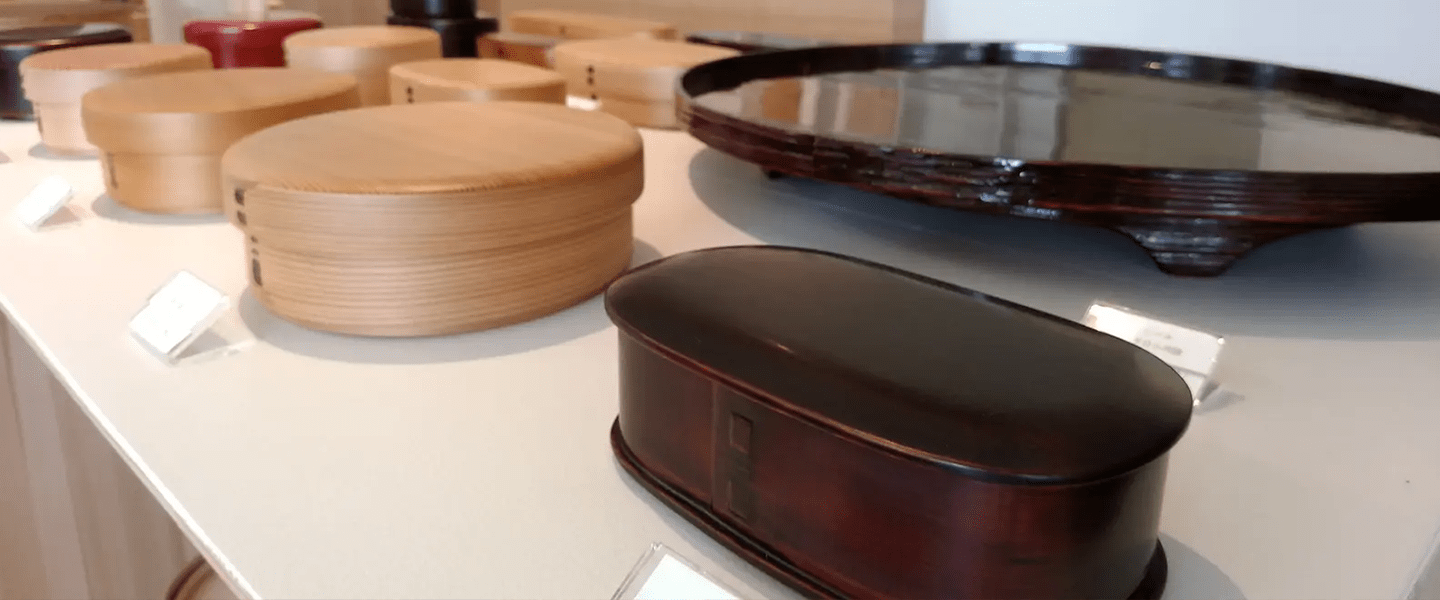
Odate Magewappa
It is said that “Odate Magewappa” originated when lumberjacks began crafting bentwood containers from straight-grained cedar.
Thin slices of natural Akita cedar—known for its elasticity and beautiful grain—are soaked in boiling water to soften them, then bent into shape and secured with mountain cherry bark to complete the process.
Its bright, elegant wood texture and uniform grain, along with its gentle, simple, natural materials, have made it popular even overseas.
Butter Mochi
When it comes to local sweets in Kitaakita, “butter mochi” is the first thing that comes to mind.
It’s made by kneading butter, sugar, eggs, and other ingredients into vertical mochi and then cutting it into pieces; there are about 13 shops certified by the Japan Butter Mochi Association.
Since the ingredients vary by maker, each shop’s butter mochi differs in taste, softness, color, and aroma, making it fun to find the one that suits your taste.
They all have a pale cream color, and their buttery flavor and unique, fluffy yet chewy texture are very popular.
Be sure to check out “Bata-Mocchi,” the promotional mascot for Kitaakita Butter Mochi! 🌟
https://kbtm.jp/#character
- Odate City
- Classic
- Eat
- Restaurant
- Souvenirs
Hanazen
Hanazen’s Chicken Rice, which won the “Eki-ben Aji no Jin” station boxed lunch contest and earned the title of “Eki-ben Daishogun.”
It’s a classic item that has been loved by locals ever since the postwar era.
It has won numerous awards for station boxed lunches. It’s characterized by tender chicken, soy sauce, and the flavor of burdock root.
It’s popular among people who want to enjoy a bento while out and about.
These takeout bentos are specially prepared to remain delicious even when cold.
To maximize their flavor, they are prepared according to the day’s temperature and humidity.
- Kami-Koani Village
- Nature and Scenery
- Souvenirs
- Summer
Koani chidori
Discovered in 1919 (Taisho 8) by Yuzaburo Kinoshita in Kami-Koani Village, this perennial orchid was named “Koani-chidori” by botanist Dr. Tomitaro Makino.
The name derives from its discovery in the Koani River basin; it has been designated as the official flower of Kami-Koani Village and is cherished as a symbol of the region.
It is a small plant, growing to a height of about 10 to 20 cm, and from early summer through summer (around June to July), it produces several delicate white or pale pink flowers. Although the flowers are only a few millimeters in size, a closer look reveals their delicate shape and beautiful patterns, making them resemble tiny butterflies fluttering through the forest.
It grows primarily on moist rocky areas and alpine grasslands, and can only be found in limited environments. Because it is sensitive to heat, its distribution is concentrated mainly in northern Japan; however, its population is extremely small, and it is a precious plant designated as “Endangered (Category II)” on the Ministry of the Environment’s Red List.
You may encounter this Koanichidori in the rich natural environment, but to preserve its beauty for future generations, it is important to avoid picking the flowers or trampling the area, and to admire them quietly.
When visiting Deep Akita in early summer, please take a moment to notice these tiny lives blooming quietly in the forest.An encounter with the Koanichidori will be a special experience with nature that can only be enjoyed here.
Additionally, at the Kamikoani Roadside Station, you can purchase Koanichidori that have been carefully cultivated by hand. They are available for sale from around late May—before the flowers bloom—through mid-June.
Nakayashiro
The Nakayama district of Odate City is located in the northern part of Akita Prefecture.
The pears harvested there are collectively known as “Nakayama Pears,” and are also called “the northernmost pears” by locals.
Due to the significant daily temperature fluctuations in this region, the pears grown here are juicy and have a concentrated sweetness.
The cultivation of Nakayama Pears began during the Meiji era, and they have a history spanning over 100 years.
They have received high praise at agricultural competitions and are recognized as high-quality pears.
Sake from Kitakari
Kitakari is a sake brewery based in Ariura, in the heart of Odate City. It is a well-known brand of sake even in Akita Prefecture, which has long been renowned as a region famous for its rice and sake. While Kitakari is by no means a large sake producer, it is a brewery that continues to take on new challenges.
One such challenge is “Snow Storage.”
Sake brewed in early winter is transported to Lake Towada and stored and aged deep within the snow.
The temperature and humidity remain constant beneath the snow, creating an ideal environment for sake aging. The sake is aged as “nama-zake” (unpasteurized sake) with live yeast until early spring, resulting in a mellow flavor.
Furthermore, driven by a desire to let as many people as possible experience and enjoy daiginjo—the pinnacle of sake craftsmanship—the brewery’s “Daiginjo Kitaakita,” developed through trial and error, is Japan’s best-selling daiginjo, thanks in part to its reasonable price point.
Being able to enjoy a rich ginjo aroma reminiscent of fresh fruit and a refreshing, crisp flavor for less than 1,000 yen is truly the culmination of Kitakari’s efforts.
Kitakari’s sake lineup includes collaborations with the Akita Dog Village and a variety of other offerings.
As a local sake from Odate, we highly recommend you give it a try.
- Kitaakita City
- Odate City
- Souvenirs
- Fall
- Winter
Akita Apples
While Aomori is famous for its apples, northern Akita Prefecture—which has a similar climate—is also a renowned apple-growing region.
In particular, apple orchards stretch across the Nakayama district of Odate City and the Fushikage district of Kitaakita City.
Apples grown in these areas, where the temperature difference between day and night is extreme, are characterized by their concentrated sweetness.
It is said that they become sweeter than other apples and develop a deeper skin color.
Up to 30 varieties of apples are grown in these areas, but “Akita Beniakari”—a variety developed in Akita and grown almost exclusively within the prefecture—offers an exquisite balance of intense sweetness and just the right amount of tartness.
It is one of the culinary delights you’ll want to savor in Akita.
While the apples themselves are available from fall through spring, you can enjoy 100% apple juice—freshly squeezed from just-picked apples—all year round.
- Kami-Koani Village
- Souvenirs
Perilla oil
"Perilla oil" is rich in the omega-3 fatty acid "alpha-linolenic acid."
It helps improve blood flow.
Since the human body cannot produce omega-3 fatty acids, they must be obtained from food (i.e., essential fatty acids).
While they are abundant in bluefish such as mackerel and sardines, they are nutrients that modern people tend to lack.
That is why “perilla oil,” which is rich in omega-3 (alpha-linolenic acid), is gaining attention.
Since alpha-linolenic acid breaks down when heated, please enjoy it by drizzling it over food or mixing it in.
We also recommend mixing it with soy sauce and using it as a salad dressing.
This perilla oil is pressed from perilla grown in Kamikoani Village. It is a fresh, cold-pressed, additive-free perilla oil.
It is sold alongside a wide variety of local specialties at the roadside station.
- Kami-Koani Village
- Eat
- Souvenirs
Kohaze Ice Cream
"Kohaze" is a local specialty from Kami-Koani.
In other prefectures, it’s called "Natsuhaze," and overseas, it’s also known as the "Japanese blueberry."
It’s said to be good for the eyes and help relieve fatigue, and its antioxidant effects—including anti-aging benefits—are said to be two to three times greater than those of blueberries.
They’re tart when eaten raw, but when made into ice cream or jam, they offer just the right balance of sweet and tart flavors.
Kohaze ice cream is very creamy and has a rich berry flavor.
It’s delicious even in the dead of winter, so it’s absolutely irresistible in the summer.
It’s sold alongside a wide variety of other local specialties at roadside stations.
Kamabuku
Kamabuku is a traditional sweet made with rice flour.
It’s shaped to resemble kamaboko.
Its official name is “kamaboko,” but in the Akita dialect, it’s called “kamabuku.”
Kamabuku has a chewy texture and a gentle, delicious flavor. It’s just the right amount of sweetness.
It comes in flavors such as sesame and pumpkin.
Why not try finding your favorite flavor of kamabuku?
Edamame Cuisine in Okuakita
Akita Prefecture produces such a large quantity of edamame that it has even ranked first in Japan for shipment volume.
Thanks to the basin-like climate in Odate City and Kitaakita City, where there is a significant temperature difference between day and night, sweet and nutrient-rich edamame grows there.
The Okuakita area is full of sweets and other products made with this local specialty, edamame!
During the edamame season, farmers’ markets, supermarkets, and producers’ direct-sales outlets are packed with people.
[Major Edamame Products]
Odate Edamame Monaka
Akita Edamame Snacks
Odate Edamame Rusk
Ao-Gaeru Edamame Stick Cake
Edamame Castella
Akita Ga-pao Rice with Morning-Picked Edamame
AKITA HASHIOKI
Edamame Soft-Serve Ice Cream
Edamame Bread
Edamame Noodles
Acacia Donuts
One of Kosaka Town’s specialty products is acacia honey.
The black locust trees (false acacia) planted throughout the town bloom profusely in June, filling the town with a sweet fragrance.
The honey harvested from these flowers is characterized by its mild flavor and refreshing sweetness. The “Acacia Donut” is a treat made with a generous amount of this honey.
Carefully harvested acacia honey is generously used in both the dough and the filling. The refined, gentle sweetness unique to acacia honey blends exquisitely with the moist dough and smooth filling, leaving a lingering aftertaste.
At events, people line up for these freshly fried, crispy donuts. With a simple, nostalgic flavor that soothes the soul, they are a signature treat of Kosaka Town.
Of course, you can purchase them at the manufacturer, Meat Toda (Toda Seika), but they’re also available at events and other venues in Kosaka Town.
The Matagi's Dream (Doburoku)
"Matagi no Yume," a nigori sake produced and sold at Uchito Onsen, is made with Akita Komachi rice grown in the fields next to the hot spring and the crisp, clear groundwater from the foothills of Mount Moriyoshi, allowing you to enjoy the simple, traditional flavor of nigori sake.
The nigori sake available at the restaurant at Uchito Onsen Matagi no Yu is the “raw” type, characterized by its effervescence, pleasant tingle, and fresh aroma.
We also sell “bottled nigori sake,” which is the “raw” type that has been pasteurized to halt fermentation.
By removing the yeast, the bottled nigori sake features a smooth umami flavor and a soft, smooth finish. *Bottled products are available by reservation only.
*Since we can only produce a limited quantity at a time, it may sell out. We kindly ask that you call Attai Onsen to confirm whether we have any nigori sake in stock.
It is also available for purchase at the “Kodawari AKITA” Select Shop.
https://kodawariakita.com/kitaakita039/
- Kitaakita City
- Hands-On Experiences and Tours
- Souvenirs
Akita Hachijo
Hachijo is a type of plant-dyed silk fabric that originated on Hachijō Island.
This craft spread throughout the country, and in Akita, a technique was developed to dye the fabric a distinctive “tori-iro” (magpie gray) using the roots of wild roses growing along the coast as a dye, earning it a reputation as “Akita Silk” and “Akita Yellow Hachijo.”
In Heisei 15, the only workshop in Akita City ceased operations, bringing its history to a temporary close; however, it was revived in Heisei 18 in Kitaakita City, and today, “Kotomu Kobo” in Kitaakita City is the sole producer in the prefecture.
In addition to bolts of fabric, the workshop offers a variety of products, including ties, pencil cases, and wallets.
*The workshop is operated by two artisans.
Please note that the artisans may be away even on days other than regular holidays, so if you wish to visit, please be sure to contact us in advance.
The roads near the workshop are very narrow, making it difficult for large buses to access the site.
Acacia Honey
The greenery lost due to smoke pollution from the Kosaka Mine during the Meiji era was spectacularly restored through the planting of black locust trees, which began in Meiji 42, and has since become the largest black locust grove in the country.
In June, more than 3 million black locust trees bloom all at once, enveloping the entire town in a sweet fragrance.
The premium-quality black locust honey produced from these flowers is popular for its rich sweetness and clean flavor; it is often referred to as the “Queen of Honey” and is regarded as a luxury product.
- Kami-Koani Village
- Eat
- Souvenirs
Chinese Lantern Jam
When you hear “hoozuki,” you probably think of the ornamental variety with red berries that taste bitter when eaten, but the “edible hoozuki” grown in Kami-Koani Village has sweet-and-sour orange berries that taste like a cross between a tomato and a plum.
It’s very fruity, and because people say you’ll never forget its taste once you’ve tried it, it’s known as “Koi Dorobou” (Love Thief).
It’s rich in vitamins and is beloved as a source of energy and for its beauty benefits.
Nemagari Bamboo Shoots
Its official scientific name is “Chishimazasa” (Genus Sasa, Subfamily Bambusoideae, Family Poaceae).
Depending on the region, it is also known as “Hime-take” or “Gassan-take” and has long been enjoyed as a wild vegetable.
In the Tashiro area of Odate City, Mount Tashiro—part of the Shirakami Mountain Range—soars to an elevation of 1,178 meters. The bamboo shoots that grow in clusters on its slopes curve from the base, leading locals to call them “Nekurumari-take” (Curved-Root Bamboo).
Because they grow in areas with heavy snowfall, they absorb a lot of moisture, making them softer and sweeter than typical bamboo shoots.
They also have a rich aroma and little astringency, so they can be cooked and eaten as is.
The peak season runs from late May to mid-June, when local bamboo shoot experts head into the mountains before sunrise to harvest them.
During the peak season, freshly harvested Negamagari bamboo shoots are available at local farmers’ markets, and in June, the “Tashiro Specialty Bamboo Shoot Festival” is held, attracting many visitors from all over the region.
https://visitakita.com/tourist-guide/event06/
Tonburi
Tonburi, often likened to “field caviar,” is made by carefully processing the seeds of the broom grass (also known as houkigusa) to make them edible.
As its name suggests, broom grass is a plant used to make brooms.
The dried stalks are bundled together to make brooms. In the fall, the plant bears many small seeds.
It is believed that the practice of processing these seeds for consumption originated in the Hina region of Odate, which remains a renowned production area to this day.
Its popping texture is just like fish roe.
The origin of the name is believed to be “Touburi,” derived from “Buriko” (the roe of the hatahata fish), which was introduced from Tang China.
Popular as a healthy food rich in dietary fiber and antioxidants, tonburi pairs perfectly with grated yam (tororo). Be sure to try it in its place of origin.
- Odate City
- Eat
- Local Cuisine
- Souvenirs
Authentic Odate Kiritanpo
"Kiritanpo" originated in the Odate and Kitakari regions. Legend has it that long ago, ancestors who had taken up residence in the mountains to work as charcoal burners or harvest Akita cedar would knead leftover rice from their mountain huts and add it to chicken hot pot or spread miso paste on it to eat—and that is said to be how it began.
Although it is known nationwide as an Akita specialty, Odate City is considered its true home.
In Odate, it has been passed down as a common home-cooked dish, becoming a taste of home, and is served in households throughout the year.
Please enjoy the authentic flavor unique to this region.
- Kitaakita City
- Hands-On Experiences and Tours
- History and Culture
- Souvenirs
Nishine Blacksmith Workshop
The Spirit of the Matagi: “Matagiyama Sword.”
The workshop of Minoru Nishine, the third-generation master blacksmith of the Nagasa school—who was himself a Matagi—has been preserved exactly as it was during his lifetime, and visitors are welcome to tour it.
Currently, his wife, Seiko, carefully maintains the workshop. She not only explains the Matagi Soul “Matagiyama Sword” but also shares valuable stories about Minoru, who was both a Matagi and a Nagasa blacksmith.
While the swords are available for purchase, we invite you to come first and foremost to experience the spirit of the Matagi and to meet the gentle, smiling Seiko.